
If you’ve ever watched a product look amazing in a demo and then collapse the moment real users hit it, you know the feeling. It’s not a bug, nor is it bad luck, and it’s not even a lack of talent. It happens because teams often build features instead of systems. A feature can be a bright, shining solution to a real problem, but a system is what keeps that solution working when things get messy, and things always get messy. Users don’t behave like the ideal personas in your slide deck. Real people have real needs, and they don’t care about your roadmap. They care about whether your product works when their life is inconvenient. That’s why we design systems before products. We don’t build features and hope they work. We build systems that can handle reality, learn from it, and improve over time, because the world doesn’t reward speed. It rewards truth.
Products Are for People, Not Demos
To understand how we think about building at Cognito, you need to start with a simple shift in perspective. Products are not made for demos. They are made for people. A demo is a controlled environment. It is clean, predictable, and forgiving. Real usage is none of those things. In real conditions, users arrive confused, impatient, distracted, or already frustrated. They ask questions that don’t follow scripts. They combine problems. They misunderstand instructions. They push systems into edge cases without meaning to. This is not misuse. This is normal human behavior. Any product that cannot survive this reality is fragile by design.
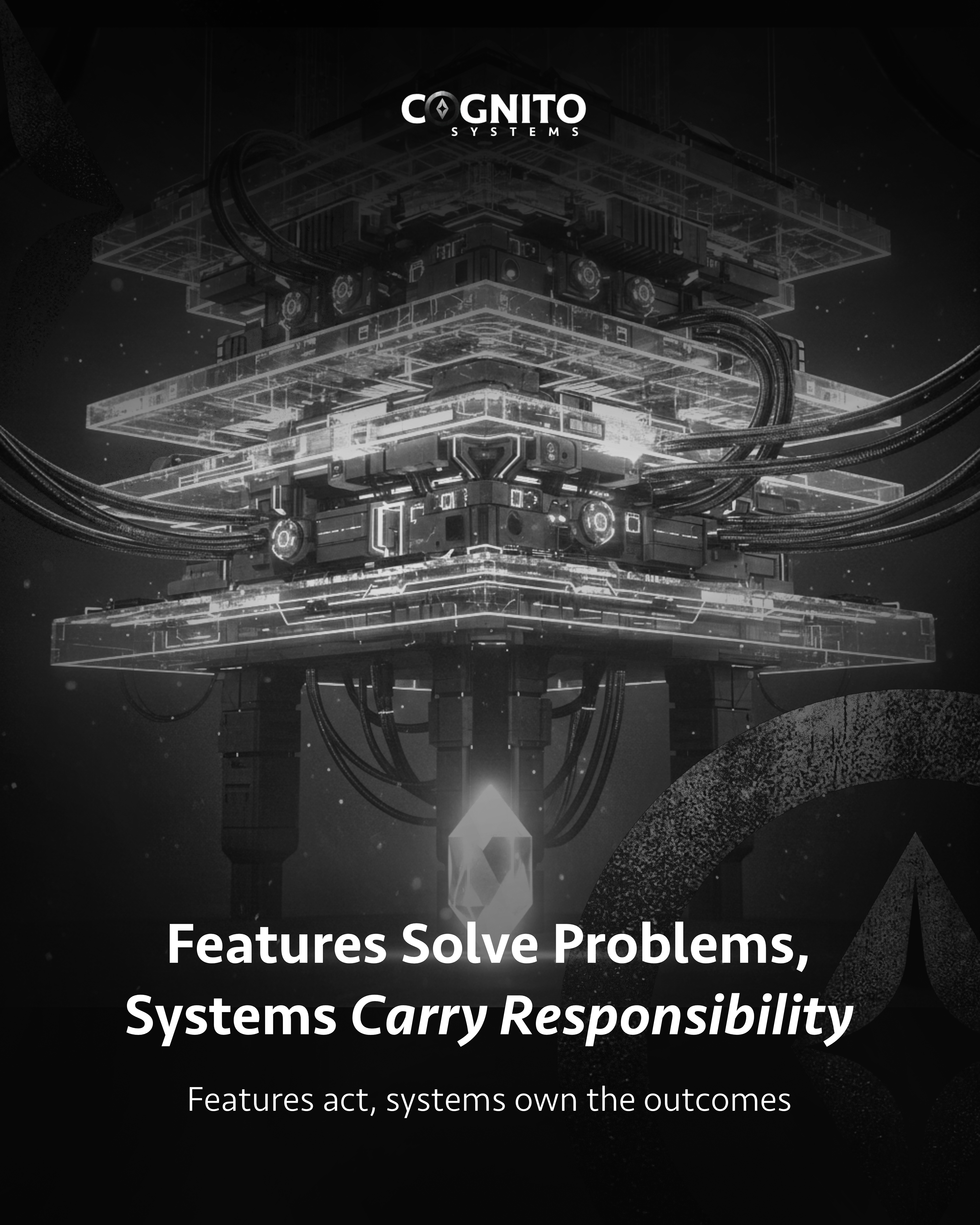
So when we say systems before products, we are talking about building for the moments that are hardest to simulate. The moments when something goes wrong. The moments when the product does not have a clear answer. The moments when a human needs to step in. If a product fails in those moments, it does not matter how fast or polished it is. Trust is lost where it matters most.
Features Solve Problems, Systems Carry Responsibility
The difference between a feature and a system is responsibility. A feature does one thing. A system takes ownership of what happens next. A feature can answer a question. A system ensures the answer is accurate, contextual, and recoverable if it is not. At Cognito, we start with the system because every feature inherits its behavior from the structure beneath it. If the structure is brittle, the feature will fail under pressure. If the structure is resilient, the feature can evolve without breaking everything around it. This is how products stay usable as they grow, rather than becoming harder to manage with each release.
Truth Over Speed, Deliberately
When you build systems first, you stop chasing the illusion of speed. Speed is seductive and sometimes feels like progress, but speed without stability is just motion. It might be moving fast, but it is not moving forward. The industry often confuses the two. A fast release is celebrated. A fast demo is praised. A fast launch is shared on LinkedIn. But none of those things prove the product is working.
We’ve seen this many times. Teams build a product with an incredible feature set, and everything looks great until real users start using it. Then the cracks appear, the edge cases show up, and the product breaks in ways the team never imagined. The team is then forced into a scramble. That scramble is expensive, both financially and psychologically. It destroys trust, it destroys morale, and it destroys the user’s confidence in the product.
A system-first approach prevents that. Speed can impress in a demo, but truth is what keeps a system usable over time.
Designing for Escalation, Not Avoiding It
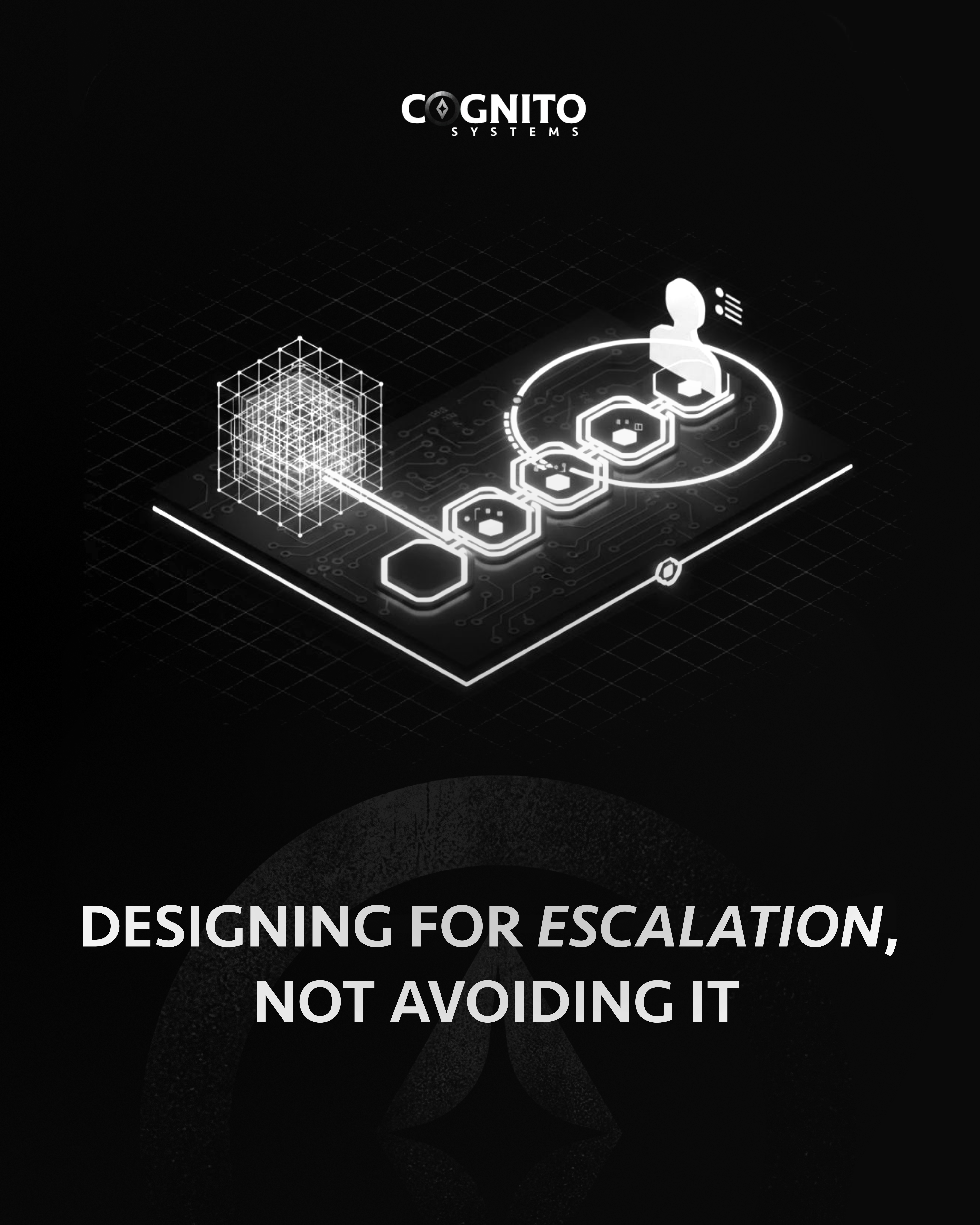
This is where escalation becomes central to the system, not a failure state. Escalation is the moment the system acknowledges its limits and hands responsibility to a human without breaking continuity. Nothing resets. No context is lost. The conversation moves forward with clarity instead of starting over in frustration.
Most systems treat escalation as an exception. We treat it as a signal. It tells us where assumptions broke down, where knowledge was incomplete, or where reality was more complex than expected. Those signals feed directly back into how the system learns and improves.
Over time, fewer conversations require escalation, not because humans are removed, but because the system becomes more accurate about when to step in and when to step aside. That is how scale happens without chaos.
Feedback Loops Over Roadmaps
Feedback Loops Over Roadmaps
Roadmaps describe intention. Feedback loops describe reality. At Cognito, we use both, but we trust feedback more. Every escalation, correction, and clarification becomes input. The system does not just resolve issues. It absorbs them.
This is how long-term thinking shows up in execution. Instead of shipping features in isolation, the system evolves through use. Instead of guessing what users need next, we observe what actually happens. This creates compounding value. The product does not just grow. It matures.
From the outside, systems that learn can look unpredictable. In practice, the opposite is true. Systems without feedback become chaotic over time because errors pile up unnoticed. Systems with feedback become more stable because friction is surfaced early and corrected continuously.
This is why Cognito is not chaotic. The system is designed to surface truth, route uncertainty responsibly, and improve with use. That discipline is what allows flexibility without collapse.
What Changes After This
When systems come before products, support stops being a cost center and becomes infrastructure. Teams spend less time reacting and more time improving. Risk is reduced because failure is expected and designed for. Growth becomes sustainable because the system scales judgment, not just volume.
For users, the experience feels grounded. Fast when it should be fast. Human when it needs to be human. Consistent even when things go wrong.
That is what systems are for. Not perfection, but reliability. Not speed for its own sake, but truth that holds up over time.
That is why we design systems before products.