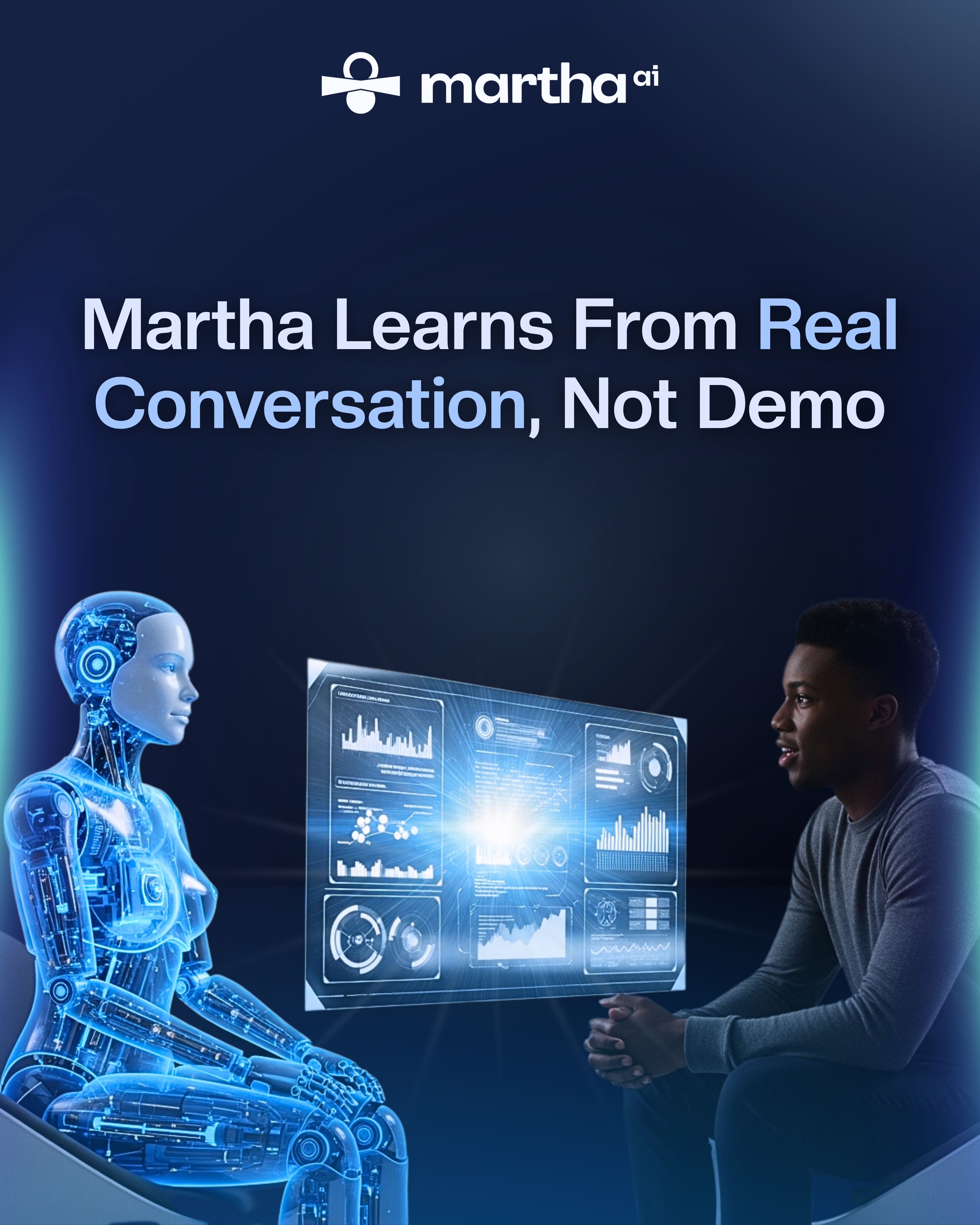
Most AI you see in demos is a performance. It works under controlled conditions, answers scripted questions, and appears capable of running a business. In production, that illusion breaks fast. Real customers ask unexpected, incomplete, and contradictory questions. When intelligence lacks context, it does not become slow; it becomes dangerous. One confident but wrong answer can damage trust, revenue, and brand credibility.
Customer interactions are messy by default. A single complaint rarely has one root cause. “My data ran out too fast” could indicate throttling, delayed billing reconciliation, network instability, or fraud. Questions arrive across channels, over time, and in fragments. Traditional AI guesses across these gaps. Guessing creates surface-level speed while quietly increasing operational risk.
The challenge is not faster responses. The challenge is building intelligence that understands what it does not yet know.
Martha is built around a simple model: every interaction exposes either a knowledge gap, a logic gap, or an intent gap. This model defines how Martha learns and how risk is controlled.
Knowledge gaps occur when required information is missing or outdated.
Logic gaps occur when existing rules do not fit a new scenario. Intent gaps occur when a customer’s underlying goal does not match the words they typed. These three gaps explain almost every failure mode in production AI.
Every Interaction Teaches Us Something New
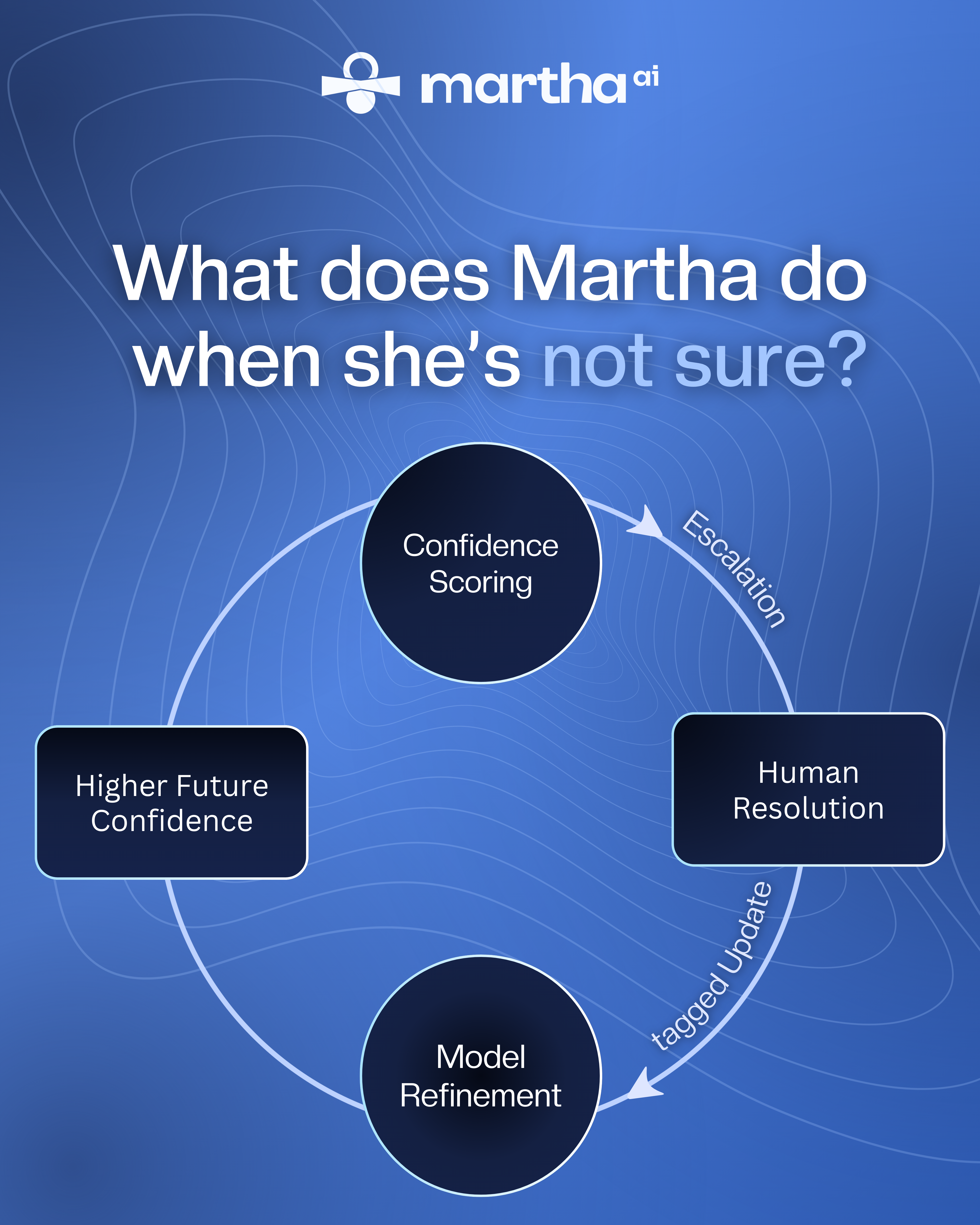
Every conversation carries signals about what the customer needs, how they ask, and which resolution actually works. Martha assigns confidence scores to each response. When confidence drops below a defined threshold, the system does not guess. It escalates.
Escalation is not a failure state. It is a risk-control mechanism.
Each escalation is automatically tagged with:
Detected gap type (knowledge, logic, or intent)
Conversation context
Confidence score at handoff
Human agent resolution
Once resolved, the outcome is fed back into Martha’s knowledge base and decision logic. This closes the gap and updates future behavior.
Over time, patterns emerge: repeated questions, recurring edge cases, and common phrasing. Martha does not patch single errors. She generalizes lessons.
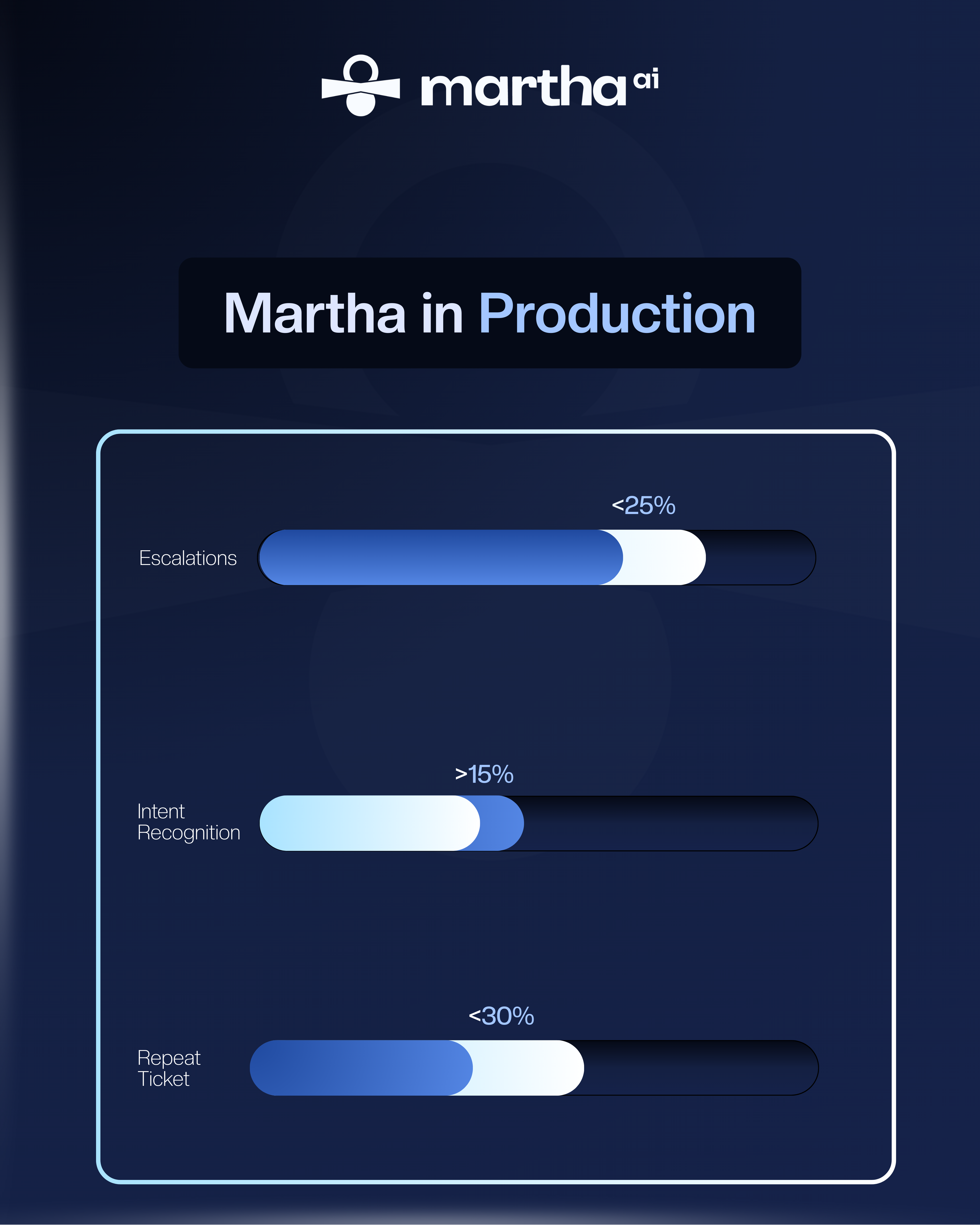
In production environments using Martha:
Escalations for recurring issues typically drop 25–40% within the first 60–90 days
Intent recognition accuracy improves 10–20% over baseline
Repeat tickets for the same issue decline by 30% or more
Average resolution time shortens as fewer conversations require human handoff
Learning is not theoretical. It is measurable.
Learning Continuously Without Guessing
Most AI systems attempt to mask uncertainty with confident answers. This creates hallucinations, silent failures, and long-term operational risk.
Martha takes the opposite approach. If confidence is high, she responds. If confidence is low, she escalates. If escalated, she learns.
This creates a closed learning loop: confidence scoring → escalation → human resolution → tagged update → model refinement → higher future confidence.
Small teams gain enterprise-level reliability. Large teams scale intelligence instead of headcount. The system improves because it is exposed to real conditions, not because it was trained harder in isolation.
Martha does not aim to look impressive in demos. She aims to be dependable in production.
Where AI Trips and Learns
The difference between demo systems and production systems appears in operational metrics: fewer escalations for known issues, faster resolution for ambiguous questions, higher first-contact resolution rates, and reduced agent time spent on repetitive requests.
Agents spend more time on complex, high-value work. Customers hit fewer dead ends. Operations gain predictability. Every conversation becomes a data point. Every escalation becomes structured feedback. Every resolution strengthens future performance. The system grows smarter, not just faster.
The Truth That No Demo Shows
Real intelligence is not defined by how well a system performs in a scripted environment. It is defined by how well it improves after being wrong.
Martha functions as a compounding operational memory. Each interaction adds context. Each escalation reduces future risk. Each resolved gap increases autonomous capability. Knowledge compounds. Logic tightens. Intent recognition sharpens.
This is not artificial intelligence as a feature, It is artificial intelligence as infrastructure.
A system that becomes more reliable the more it is used. A system that learns from reality, not rehearsals. That is what demos cannot show.