Most AI customer service deployments do not fail because the model is bad. They fail because the system around the model is weak.
A company can add AI to support, automate replies, reduce first-response time, and still end up with a support operation that feels fragmented, inconsistent, and harder to trust. From the outside, that often gets blamed on the model. In practice, the failure usually starts earlier.
It starts when customer support is treated like an answering problem instead of an operations problem.
A lot of teams approach AI in support with the wrong question. They ask: how do we answer faster? Or how do we automate more conversations without adding headcount? Those are not useless questions, but they are incomplete.
Because support quality is not just determined by how quickly a message gets answered. It is determined by what happens to context as the conversation moves through the system.
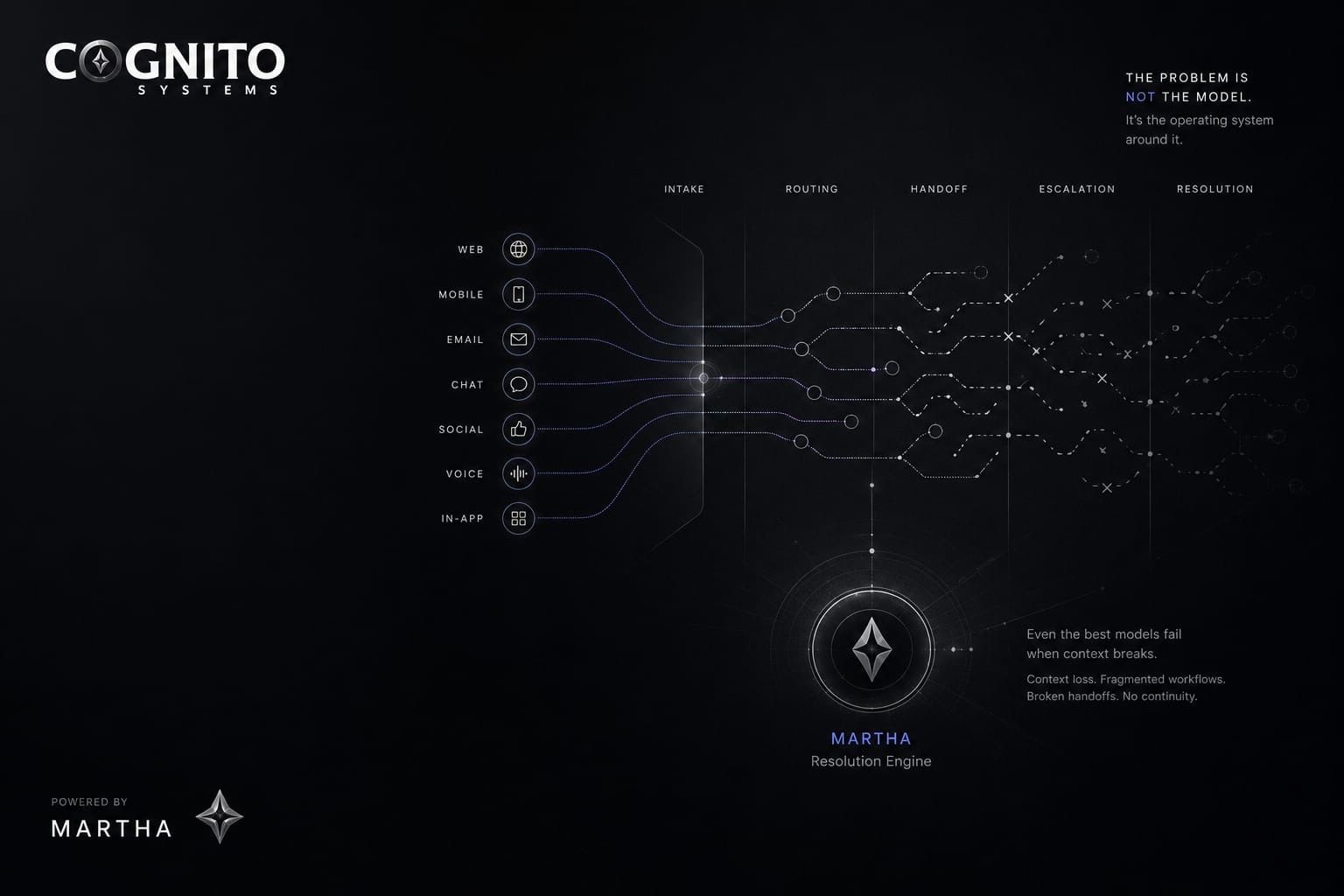
If a customer starts on one channel, gets handed to another queue, reaches a different agent, triggers an escalation, and still has to repeat the same history, the issue is not a lack of AI. The issue is that context is not surviving the workflow. That is where a lot of deployments quietly start to fail.
Teams often do not notice this immediately because the early signals look small:
● a handoff without history
● an escalation with no useful context
● a repeated explanation
● a support agent re-collecting information that should already exist
● a conversation that becomes slower and less accurate as more systems get involved
At first, these look like minor inefficiencies. But they compound quickly.
By the time leadership sees a visible support problem, it often looks like volume. Queue pressure rises. Resolution quality drops. Operators feel overloaded. Customers become harder to retain. The natural reaction is to think the team needs more coverage, more automation, or faster replies.
But volume is often just the moment the underlying weakness becomes impossible to ignore. The actual failure usually started earlier, when context began collapsing across the support workflow.
What Failure Looks Like in Practice
Most AI customer service deployments do not collapse in one obvious moment. They erode in smaller ways first.
A customer asks for help on one channel, but the relevant history sits somewhere else. An agent responds, but without the full context needed to make a good decision. The issue gets moved, but the handoff carries almost no usable continuity. An escalation happens, but the next operator has to reconstruct the case instead of advancing it.
The result is a support system that stays active while becoming less intelligent. That is the real danger.
A lot of automation can create the appearance of progress:
● more replies
● faster first-touch response
● more conversations handled
● more surface-level efficiency
But if the system is still losing context between agents, channels, queues, and escalations, then activity is increasing faster than clarity. And when activity rises without clarity, support quality becomes unstable.
That instability usually shows up in familiar ways:
● customers repeat themselves across channels
● agents spend time reconstructing conversations
● escalations become slower and less reliable
● the quality of resolution becomes inconsistent
● internal teams lose confidence in what the support layer actually knows
● automation creates motion without reducing operational confusion
Why Teams Misdiagnose The Problem
They see pressure and assume the problem is volume. They see delays and assume the problem is staffing. They see inconsistent outcomes and assume the AI itself is underperforming.
Sometimes those things are true. But in many cases, they are secondary effects.
The deeper problem is that the support system was never designed to preserve decision-quality context as the workflow gets more complex.
That is why support often gets worse before it gets better when AI is added too early or added too narrowly. If the system underneath is fragmented, AI does not remove the fragmentation. It often accelerates it.
A weak process with more automation does not become intelligent. It becomes faster at producing inconsistent outcomes.
That is why serious support systems need to be designed around more than just response generation. They need to be designed around:
● context continuity
● routing logic
● escalation discipline
● visibility across workflows
● resolution quality, not just reply speed
Because the real job is not just answering the customer. It is making sure the system around the answer stays coherent from start to finish.
The teams that get the most value from AI in support will not be the ones that automate the fastest. They will be the ones that design the cleanest system around the conversation.
That is the operating layer MARTHA is built for.
Not generic automation layered on top of chaos, but a customer operations system focused on context, routing, escalation, and resolution.
Because in serious support environments, the question is not just whether the system can answer. It is whether the system can preserve enough clarity to make the answer useful.