Every week, a new AI tool arrives with the same promise: more leverage. A new copilot for writing. A new agent for research. A new assistant for support. A new workflow layer for sales, operations, or engineering. Each one offers the same basic proposition work faster, move smarter, scale output without scaling effort.
And in isolation, many of them do exactly that. An employee can draft a proposal in half the time. A support agent can summarize a long thread instantly. A product team can turn a pile of notes into a clean document before a meeting even starts. The local productivity gains are real.
But inside many organizations, something else is happening.
Teams are writing more, automating more, and generating more but they are not always understanding more. They are not always deciding better. In many cases, they are becoming more fragmented.
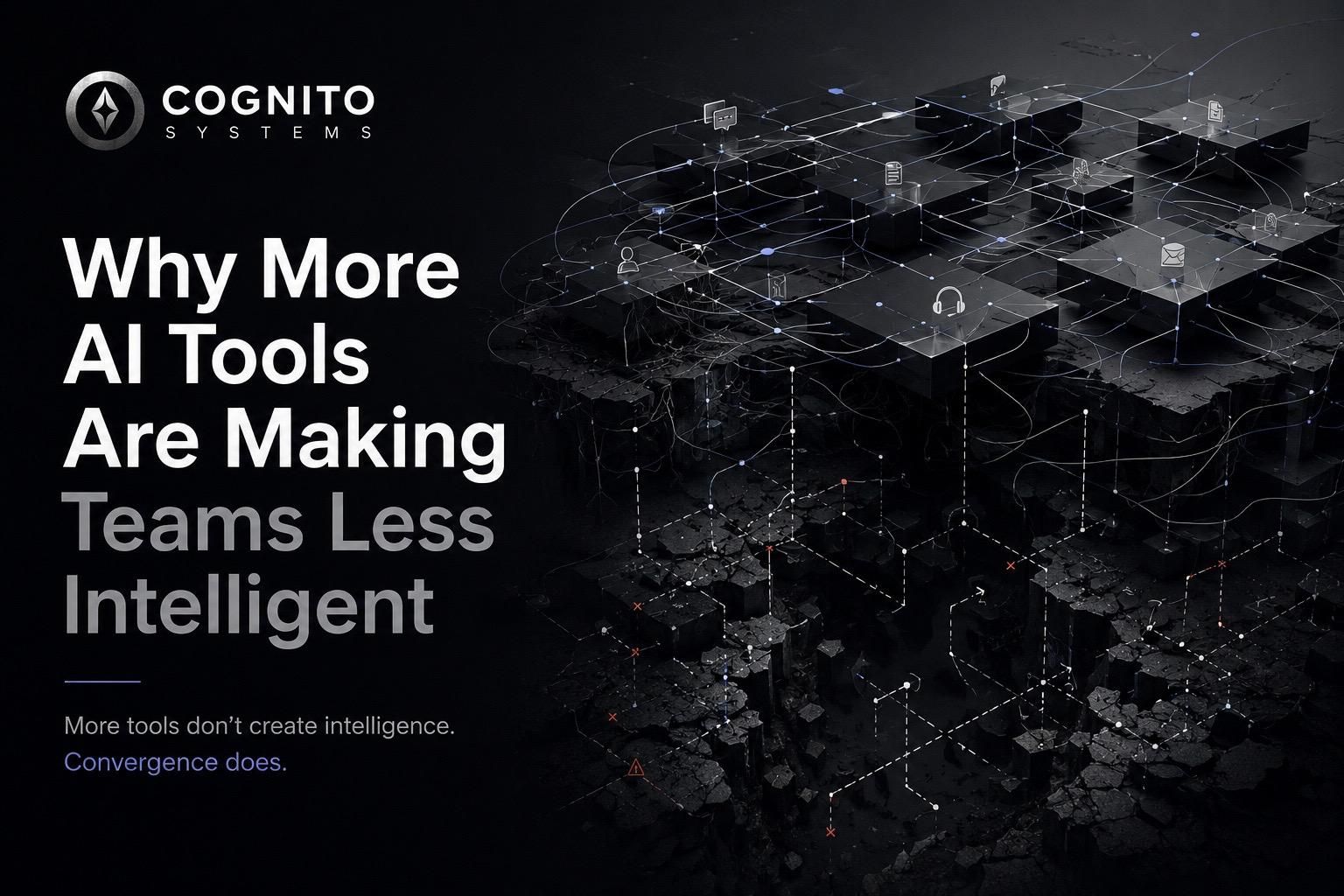
This is the real AI productivity paradox: more tools are making people faster in pieces while making the organization weaker as a whole.
Most companies are using the wrong frame
That sounds backwards until you define intelligence correctly. Most companies still think intelligence is something you buy at the tool layer. If the model is strong enough, the company becomes smarter. If enough employees have copilots, the organization becomes more intelligent. If enough workflows are automated, intelligence must be rising.
That is the wrong frame. Consider what intelligence actually is, inside an organization:
Speed is not intelligence.
Output is not intelligence.
Automation density is not intelligence.
Intelligence, inside an organization, is the ability to integrate multiple relevant perspectives into a single better decision. It is the ability to preserve context as work moves to keep signal alive across teams. To make sure what support learns can improve what product decides. To make sure what finance sees can shape what operations does. To ensure that information does not die in the gaps between systems, teams, and tools.
That is a much harder problem than response generation. And it is where many AI deployments start to fail.
More AI tools means more surface area, not more intelligence
The first thing most companies increase when they adopt more AI is not intelligence, it is surface area. Now there is an assistant in email, another in documents, another in support, another in engineering, another in CRM, another in meetings, another in analytics, another in internal search, another doing outbound, another routing tickets, another summarizing calls.
Each tool may be useful in its own domain. Each may improve the speed of a local task. But very few improve the architecture that connects those tasks. This is the core mistake: companies are mistaking distributed capability for integrated intelligence.
The difference matters more than it sounds. A tool can be locally brilliant and systemically corrosive. It can make one part of the workflow more efficient while making the broader system harder to trust. It can reduce effort at one node while increasing coordination cost everywhere else. It can produce cleaner outputs while multiplying the number of places context can split, drift, or disappear.
That is what many organizations are now paying for. Atlassian recently described part of this pattern as an AI fragmentation tax — teams may feel more productive while still losing significant time to duplicated work, unclear priorities, and coordination chaos. That language is useful because it names the real issue: the local gains are real, and the systemic losses are real too.
This is not isolated to one vendor or one workflow category. The same concern is now surfacing in discussions about AI sprawl, agent sprawl, orchestration overhead, and the productivity paradox. The language varies. The structure of the problem does not.
The question no one is solving: what happens to context?
Each new AI tool optimizes for its own slice of work. One drafts. One analyzes. One routes. One summarizes. One automates. One answers. But very few solve for convergence, the harder question: what happens to context as work crosses boundaries?
What happens when customer information moves from support to operations?
What happens when product feedback moves from sales into roadmap decisions?
What happens when finance sees one reality, operations sees another, and leadership makes decisions without a system that can integrate both cleanly?
What happens when multiple tools produce partial truths, but no architecture exists to synthesize them into one reliable operational picture?
That is where intelligence starts to fail. Not because the models are weak because the system is.
Two patterns that reveal the problem
You can see this clearly in customer operations. A support team might use AI to summarize tickets faster, classify issues faster, and generate replies faster. On paper, that looks like progress. But if customer history still breaks across channels, if escalations still happen without continuity, if the same customer has to repeat the same issue across multiple handoffs then the system has not become more intelligent. It has become faster at moving broken context.
The problem was never just the speed of the reply. It was whether the workflow could preserve enough signal to make the reply useful.
The same pattern appears in product and engineering. A team can now generate specifications faster, summarize calls faster, or extract action items faster. But if strategic context is split across Notion, Slack, Jira, email, a meeting assistant, and three AI copilots that each hold partial memory, then the organization starts making decisions from fragments. Everyone is informed. No one is converged.
The hidden cost: perspective loss
This is where the real cost begins and it is not just software cost, not just tool sprawl. It is perspective loss.
One team sees one truth. Another sees another. A summary gets compressed. A signal gets softened. A risk becomes a note. A pattern becomes an anecdote. A real operational problem gets mistaken for noise because the architecture of the company cannot carry the perspective far enough without degrading it.
The irony is that many companies adopt AI because they believe it will make them more adaptive, more informed, and more intelligent. But when adoption happens at the task layer without redesign at the coordination layer, the opposite often happens. The organization becomes more active without becoming more aware.
That is why so much current AI adoption feels impressive from the outside and unstable from the inside. The demos are strong. The interfaces are polished. The individual use cases are persuasive. But the system underneath remains confused.
We are measuring the wrong things
Too much of the AI conversation is still measured in tasks completed, outputs generated, or time saved. Those metrics matter, but they miss the harder question. What is happening to decision quality? What is happening to continuity? What is happening to the number of perspectives that actually survive long enough to shape what the organization does?
That is the real measure of intelligence. And that is where more AI tools can quietly make teams worse. Not because the tools are bad because the architecture is weak.
A weak system with more AI does not become intelligent. It becomes faster at producing fragments, or faster at hiding fragmentation behind polished outputs. The company starts to feel more advanced than it really is. The stack looks modern. The workflows look optimized. Employees feel individually augmented. Leadership feels like transformation is underway.
But when pressure hits, the truth surfaces quickly:
A customer issue crosses departments and falls apart.
A product decision is made from incomplete context.
A financial reality arrives too late to matter.
A risk is visible in one team and invisible to the people making the call.
The organization looks intelligent at the edges and blind at the center. That is not an AI success story. It is an architectural failure disguised as adoption.
What will actually separate the winners
The companies that will benefit most from AI will not be the ones that install the most tools. They will be the ones that design the clearest systems around context, convergence, and continuity. They will understand that intelligence is not a property of the model alone, it is a property of the operating architecture.
The real question is not how many AI tools your company has. It is what happens to signal as it moves through the company.
Does context survive?
Do perspectives converge?
Do decisions improve?
Does the system become easier to trust as complexity rises?
If the answer is no, then the company is not getting more intelligent. It is just getting more crowded.
In the next phase of this cycle, crowded systems will lose to coherent ones. Because the future will not belong to the teams with the most AI, it will belong to the teams whose intelligence can actually converge.