The Starting Point
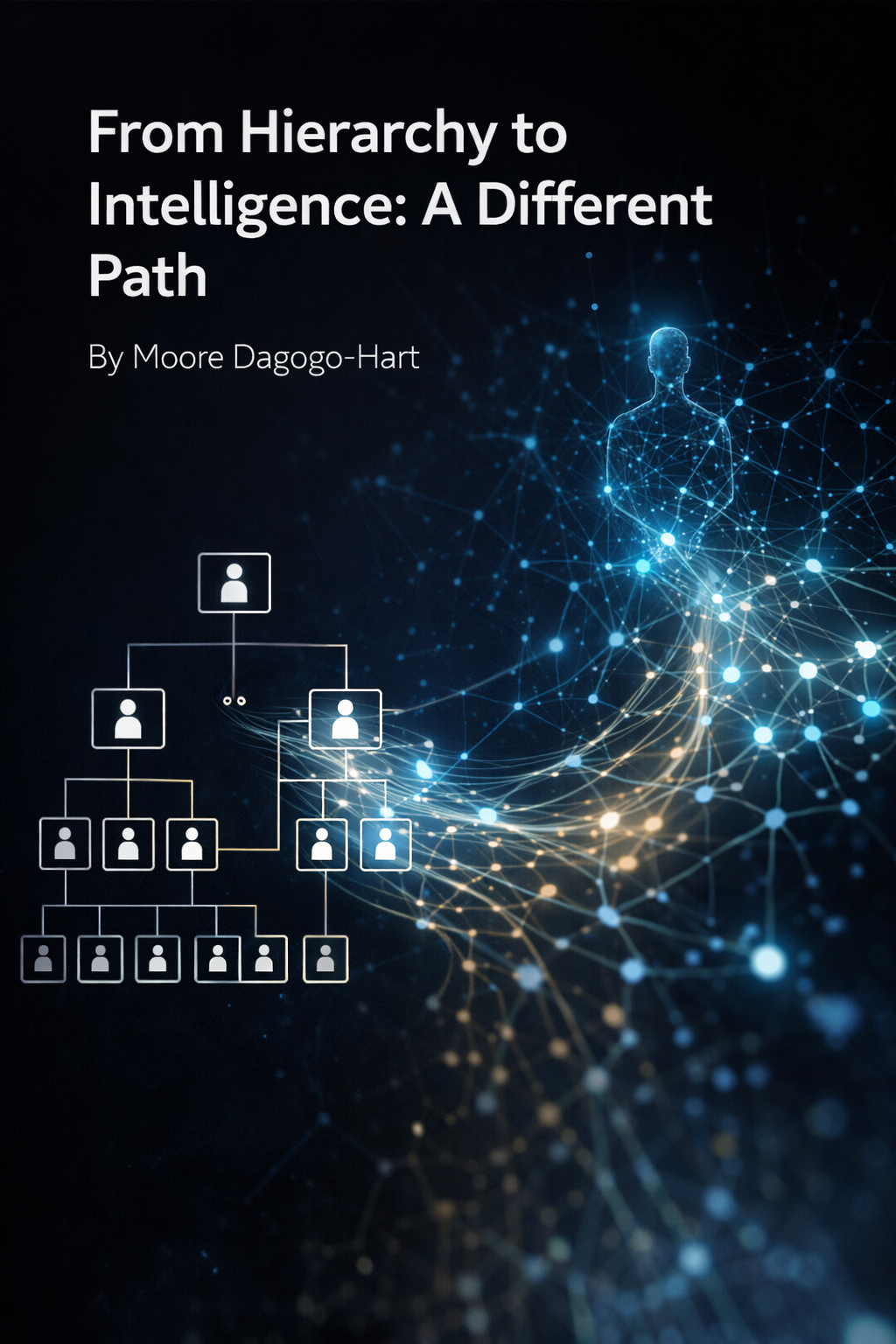
Earlier this year, Jack Dorsey and Roelof Botha published an essay called “From Hierarchy to Intelligence.” It was simultaneously posted on Block's website and Sequoia Capital's. The timing was deliberate. Weeks earlier, Block had cut roughly 4,000 employees — nearly 40% of its workforce. Dorsey framed the cuts not as layoffs but as the beginning of a permanent restructuring. The stock surged over 20%.
The essay's thesis is clean: corporate hierarchy is an obsolete information routing protocol. It was invented two thousand years ago to solve coordination at scale under human cognitive limits. Managers exist to aggregate context from below, relay decisions from above, and maintain alignment across teams. AI can now do all of that continuously and at scale. The messenger is redundant.
I read the essay three times. Not because I disagreed. Because I had been building and testing a version of this thesis for weeks before it was published. And I arrived at a different conclusion.
The Part Dorsey Gets Right
He is correct about the diagnosis.
Hierarchy was designed as an information routing system. The Roman Army's structure — eight soldiers under a decanus, eighty under a centurion, five thousand under a legate — was not about authority for its own sake. It was about the physical constraint of human communication. A leader can effectively manage somewhere between three and eight people. Every layer of management exists because the one above it cannot hold more than a handful of direct relationships.
Two thousand years later, that constraint still governs every large organization on earth. McKinsey's matrix. Spotify's squads. Zappos' Holacracy. Valve's flat structure. Each experiment revealed the limitations of hierarchy, but none escaped the underlying problem: humans have a finite bandwidth for integrating information, and organizations generate more information than any single human can process.
Dorsey is right that AI changes this equation. A system that can continuously aggregate internal data — from code, from decisions, from workflows, from performance metrics — can create a picture of company operations that no middle manager could maintain in their head. The information routing that required human intermediaries can now, in theory, happen at machine speed.
This is the correct diagnosis. Where I differ is the prescription.
Replace or Activate
Block's answer: remove the humans who were routing information, and replace them with AI. Fewer people, more intelligence. The organizational chart flattens not because the hierarchy is restructured, but because the layers that existed to route information are eliminated entirely.
This works if you believe that the primary function of people in an organization is to move information. If managers are messengers, and the message can be delivered by machine, then the messenger is indeed redundant.
But that framing misses something. The people inside an organization are not just routing information. They are generating it. Every team member who interacts with a customer, builds a feature, processes a transaction, or solves a problem is producing signal that the organization needs to make good decisions. The question is not whether AI can route that signal faster than a human manager. The question is whether the signal is being generated, captured, and integrated at all.
In my experience running two companies from Lagos — one processing millions in crypto transactions, the other building AI infrastructure — the bottleneck was never routing speed. It was perspective loss. The signal existed inside the organization, but it died before reaching the point of decision.
What Actually Kills Intelligence
I started studying this problem not from theory but from frustration.
Decisions were being made with incomplete information. Not because the information did not exist, but because the structure of the organization prevented it from converging. The customer's experience arrived as isolated support tickets — the pattern across hundreds of tickets was never synthesized. The engineering team's concerns about system fragility were heard as technical complaints rather than strategic intelligence. The finance team's reality arrived monthly in a report that described the world as it was four weeks ago. The operations team's real-time knowledge lived in chat messages that nobody summarized.
Each of these perspectives contained signal that the decision-maker needed. But by the time the decision was made, most of them had been lost, filtered, compressed, delayed, or simply never collected.
I started calling this perspective loss — the systematic death of relevant viewpoints before they reach the point of decision. And I realized it had specific, diagnosable causes:
No carrier. Nobody's job is to collect and deliver that perspective. The customer's voice has no designated carrier, so it arrives as anecdote rather than analysis.
Cadence mismatch. The perspective arrives, but too slowly. Monthly reports in a company that makes weekly decisions.
Translation loss. The perspective passes through intermediaries who compress or reinterpret it. An engineer's concern about system fragility becomes “the team says it's manageable” by the time it reaches the founder.
Dominance. One perspective — usually the founder's — is so strong that it absorbs all others. Every signal passes through the dominant lens. The leader feels like they are integrating multiple perspectives, but they are actually integrating multiple filtered echoes of their own perspective.
This last one was the hardest to confront. Because in a company I built, the dominant perspective was mine.
The Experiment
The theory hit me suddenly, but the test was deliberate. I wanted to know: if I changed the structure — not the people, the structure — would the intelligence of the organization actually improve?
I defined intelligence precisely: the ability to integrate multiple relevant perspectives into a single decision. And I built a measurement system. For every major decision the company made, I tracked how many distinct perspectives were present at the point of decision. Not how many people were in the room. How many genuinely different viewpoints shaped the outcome.
Then I made structural changes. Not layoffs. Not AI replacement. Architectural changes to how information flowed.
I designated signal stations — specific points in the organization responsible for generating and delivering a particular perspective. The customer perspective had a station. The financial perspective had a station. The engineering perspective had a station. Each station had a carrier — a person whose job included not just doing the work, but synthesizing what the work revealed and delivering it to the decision point.
I introduced carrier analysis — a regular check on whether each perspective was actually arriving. Not whether the report was filed. Whether the signal was reaching the decision and influencing it. There is a difference between a report that exists and a perspective that is integrated.
I added outcome verification — a weekly check on whether the previous week's decisions had worked. Not assumed. Measured. The feedback loop that most organizations never close. Did the decision produce the expected result? If not, which perspective was missing?
The change showed within weeks — not as a headline number I'm ready to publish, but in the decisions themselves. The same people, in the same roles, at the same salaries, were now operating in a structure that let their intelligence actually reach the decisions that mattered.
Our content lead went from executing briefs to independently proposing strategic positioning for the entire company. Our growth lead proposed a structural merge of two teams that I had not considered. Our engineering team started flagging architectural risks weeks before they became crises, because they now had a carrier that ensured their perspective reached the decision point instead of dying in a Slack thread.
The people did not change. The architecture changed.
The Difference
This is where I respectfully diverge from Dorsey.
His model treats people as the constraint and AI as the solution. Remove the human routing layer, install AI routing, and the organization becomes an intelligence. It is elegant and it may work at Block's scale.
But it carries an assumption: that the primary value of people in an organization is information routing. If that is true, then replacing them with AI is logical. If it is not true — if people also generate, interpret, and create the signal that the organization needs — then removing them removes intelligence rather than adding it.
What I found is that people are not the bottleneck. Structure is the bottleneck. The same people who appeared to be underperforming in a broken structure became strategic thinkers in a well-designed one. The intelligence was always there. It was trapped.
Dorsey's path: fewer humans + AI routing = organizational intelligence.
The path I am testing: right humans + right architecture = organizational intelligence.
Both paths lead to the same destination — an organization that integrates perspectives faster and more completely than traditional hierarchy allows. But one achieves it by subtraction. The other achieves it by activation.
What This Means
I want to be careful here. I am not claiming my approach is better than Dorsey's. Block is a public company with $12 billion in gross profit guidance. I am running two startups from Lagos. The scale, the context, and the constraints are radically different.
But I do believe the underlying principle holds regardless of scale: intelligence is not a trait of individuals or machines. It is an architecture. It is the structure that determines how many perspectives reach the decision point, and whether the outcome is verified and fed back into the system.
You can build that architecture with AI. You can build it with humans. You can build it with both. But you cannot build it by simply removing layers and hoping that speed replaces depth.
The organizations that will thrive in this era are not the ones that move fastest. They are the ones that integrate the most perspectives per decision. Speed without integration is just faster blindness.
Hierarchy is dying. On that, Dorsey and I agree completely. What replaces it is the question. His answer is artificial intelligence as the coordination layer. My answer is intelligence itself — human, artificial, or hybrid — as the integration layer. Not routing information faster, but ensuring that the right perspectives converge on every decision that matters.
Intelligence is not a product you install. It is an architecture you design. And architectures can be built anywhere — including from a flat in Lagos with a team of thirteen.
This is the question Cognito Research studies, and the flow the Dagz diagnostic measures — where customer, financial and operational perspectives reach, or fail to reach, the people making decisions.
About the Author
Moore Dagogo-Hart is the Founder and CEO of Cognito Systems, an AI infrastructure company building the decision-synthesis layer for organizations. He is also the Co-Founder and CTO of Zap Africa, Nigeria's first non-custodial crypto exchange.